
Services
Fire Collar Supply and Installation in Brisbane
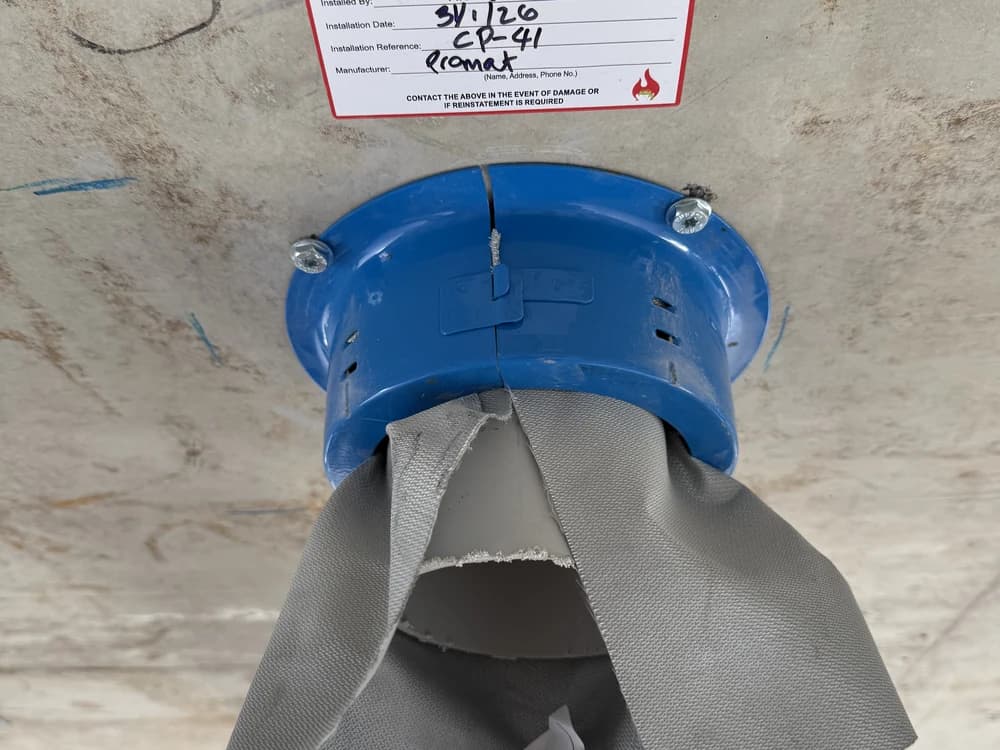
Fire Frog supplies and installs intumescent fire collars on PVC, HDPE, PP and other plastic pipe penetrations through fire-rated walls and slabs, on new builds and as retrofit collars in existing buildings.
Each collar is rated for a specific pipe material, outside diameter, wall or slab construction and fixing pattern, and that combination is what was tested. Fire Frog sizes each collar against the manufacturer's tested detail, fixes it as the system requires, and labels it so the next person can see what is there.
The same riser usually carries copper, cable and conduit alongside the plastic, so the collar is scoped as part of a sealed penetration that also takes fire stop sealant, wrap or coated batt around the rest.
New-build work is straightforward when the pipework is set out and the penetrations are clean. Retrofit is the other half of the work: a building already occupied or at handover where a plastic service needs a collar fitted around it.
What we cover
- ✓Pipe material, diameter and substrate checked before any collar is ordered
- ✓Collar selection matched to the manufacturer's tested detail for that combination
- ✓Retrofit collars for live services and cast-in or surface-mounted collars on new work
- ✓Fixings to the tested pattern
- ✓Fire stop sealant or coated batt around the balance of the penetration
- ✓Labelling at each collar recording the system installed
- ✓Certification of the completed installation on request
Retrofit fire collars
Retrofit is the highest-volume collar job and it is the one with the tightest constraints. The pipe is in, the ceiling may be closed, and the collar has to be fitted around a live service without cutting it out. Split and hinged retrofit collars exist for exactly this, and they carry their own tested details and their own fixing requirements, which are not the same as the cast-in or new-build versions.
- Retrofit collars fitted around live plastic services without cutting the pipe
- Cast-in and surface-mounted collars on new-build slabs and walls
- Slab-underside and wall-face fixing to the tested pattern for the substrate
- Make-good and re-seal of the surrounding penetration at the same time
Which pipes need a collar
Any combustible or thermoplastic service through a fire-rated element is the usual trigger. That covers PVC and uPVC waste and stormwater, HDPE, polypropylene, and plastic-jacketed insulated services. Metallic pipework generally takes a different system rather than a collar, and mixed penetrations take both.
- PVC and uPVC waste, vent and stormwater lines
- HDPE and polypropylene drainage
- Insulated services with a combustible jacket or lagging
- Mixed openings where plastic and metallic services share one core hole
How a collar is sized and fixed
Sizing starts with the pipe's outside diameter and material, then the element it passes through: the construction type, the rating required and the thickness. That combination selects the collar and the tested detail, which in turn sets the fixing type, the number of fixings and their spacing. Fire Frog works to that detail and records the collar type and location on completion, so the installation can be certified without anyone guessing what was fitted.
Why choose Fire Frog?
The contractor who fits the collar is the one who certifies it, so there is no second trade to chase at handover. Every collar is matched to the manufacturer's tested detail for that pipe and substrate, and labelled with the system used. Retrofit collars around live services, including fixing collars a certifier has knocked back, are a large part of the work across Brisbane, the Gold Coast, the Sunshine Coast, Ipswich and Logan.
Common questions
Can a fire collar be fitted to a pipe that is already installed?
How much does a fire collar cost?
Does a copper or steel pipe need a collar?
Do you supply the collars or do we?
Where we work
Passive fire protection across South East Queensland
New build, rectification and annual survey work on commercial projects.
Passive fire protection, firestopping and certification on commercial projects across South East Queensland.
Working on a project elsewhere in South East Queensland?
Get in touch